Jump to a part of the video
Can neck problems affect your brain?
Yes. The upper neck is packed with position sensors that report to the brainstem and cerebellum, and the arteries that feed the back of the brain climb through the neck bones. When those signals go wrong or those arteries get squeezed, it can show up as dizziness, headaches, blurred vision, heart rate spikes, brain fog and memory problems.
Most people think of the neck as a simple structure that holds your head up, turns left and right, and sometimes gets stiff. The cervical spine is also one of the most neurologically dense regions in your body. Its small, deep muscles carry far more position sensors for their size than the large muscles around them (Peck, 1984), and those sensors constantly tell your brain where you are in space, how to steer your eyes and how to run your autonomic nervous system.
When cervical joints develop errors from whiplash, falls, repetitive strain or postural breakdown, the effects reach far beyond neck pain. In many cases the neck is quietly driving symptoms that get blamed on the brain, the inner ear or anxiety.
1. Neck Problems Can Cause Dizziness and Balance Problems
Your brain works out where you are in space by combining 3 inputs: your inner ears (the vestibular system), your eyes and the position sensors in your neck joints and muscles. These 3 streams are supposed to agree. When they agree you feel stable, and when they don't you feel dizzy, off-balance or like the world is moving when it shouldn't be.
When the eyes, inner ears and neck agree, the brainstem and cerebellum can keep you steady.
Your cervical spine is packed with proprioceptive receptors, the sensors that tell your brain exactly where your head sits relative to your body. When neck joints are injured or not moving well, these receptors start sending inaccurate information. Now your neck is telling your brain one thing, your ears are saying something else, and your eyes are reporting a third version of reality.
The size of the mismatch sets the size of the symptoms. A small discrepancy might cause subtle unsteadiness, while a large one can produce full vertigo, nausea and the feeling that you're constantly falling. Researchers call this cervicogenic dizziness, and it often travels with problems holding head position and controlling eye movements (Kristjansson and Treleaven, 2009). Knowing the 5 types of vestibular dysfunction matters here, because the cervicogenic type is one of the most frequently missed. It's why so many people with chronic dizziness have a history of whiplash, concussion or falls that nobody connected to their balance.
2. Neck Problems Can Affect Your Eyes and Vision
This one surprises people: your neck and your eyes are tightly linked, because neck position feeds the reflexes that aim your eyes. Changes in your neck can affect binocular vision, focusing, depth perception and how you handle light.
People often describe blurry vision, visual overwhelm in busy places, trouble reading, or eyes that can't keep up. They see the eye doctor, hear that their eyes are healthy, and leave confused. The eyes usually are healthy, and the faulty input is coming from the neck.
These are neck problems showing up in the visual system, so until the cervical input is addressed, new glasses or vision therapy on their own rarely resolve them.
3. Cervicogenic Headaches: How the Neck Causes Head Pain
Most people know neck problems can cause headaches, and the pattern depends on which structures are involved.
Irritated neck muscles with trigger points create musculogenic headaches, with referral patterns that wrap around and settle behind the eyes. This is the familiar tension headache.
When the joints themselves are involved, the pattern changes. Arthrogenic headaches, driven by joint dysfunction, tend to wrap around the head like a band of pressure.
The neck also carries arteries going up to the brain, veins coming back down, the sympathetic chain and the vagus nerve. Cervical joint problems can compress or irritate any of these, which is one mechanism behind migraine as a neurological event. Each one produces a different quality and location of headache, which is why "headache" as a single diagnosis says little until you know what's driving it.
4. Cervicogenic Dysautonomia: How the Neck Drives POTS Symptoms
Your cervical spine is tightly wired into your autonomic nervous system. Faulty joint input overstimulates the brainstem or feeds it inaccurate signals, and the brainstem is where autonomic reflexes are coordinated, so bad information in produces bad output. In animal studies, stimulating the nerves from the upper neck muscles at low intensity changed both sympathetic and breathing nerve activity (Bolton, 1998).
The result can be heart palpitations that seem to come out of nowhere, digestive problems such as bloating, SIBO or alternating constipation and diarrhea when the vagal pathways that move the gut are disrupted, and temperature swings where you can't get warm or you overheat at the wrong times.
If you have POTS or dysautonomia, check the neck. Many people with autonomic dysfunction have cervical joint errors that keep feeding the brainstem faulty position data, and the brainstem answers with the heart rate spikes, blood pressure swings and gut problems that define dysautonomia. Until that input is corrected, the brainstem keeps responding to bad information. It's one of the most overlooked contributors to autonomic dysfunction, and one of the most treatable.
Wondering whether your neck is part of your POTS? The free POTS Roadmap walks through the 6 steps our team uses to find what's driving symptoms and where to start.
Get the free Roadmap5. Neck Problems Can Impair Coordination
Your cerebellum, the part of your brain that handles coordination, motor timing and movement precision, relies heavily on position input from the cervical spine. It needs accurate information about head and neck position to calibrate every movement you make.
When cervical position errors feed bad data to the cerebellum, coordination suffers. Movements feel slightly off, you're clumsier than you used to be, and tasks that need fine motor precision get harder. Some people describe a delay between deciding to move and moving smoothly.
In these cases the cerebellum itself is healthy and is processing corrupted input from the neck, so when the input improves, cerebellar function often improves with it.
6. Can Your Neck Affect Blood Flow to the Brain?
The vertebral arteries, 2 of the 4 major arteries that supply your brain, run directly through the cervical vertebrae. Each one climbs through a bony tunnel in the side of each neck bone on its way to the brainstem and the back of the brain.

When the cervical spine changes through joint misalignment, disc problems, muscle spasm or ligament laxity, these arteries can be squeezed from the outside. This is called extraluminal compression, and it works like a foot on a garden hose that's otherwise in good shape.
The result is reduced blood flow to the brain. It's rarely enough to cause a stroke, but it can be enough to cause lightheadedness when you change position, visual disturbances, slowed thinking and fatigue. It's especially common in people whose symptoms get worse with certain head positions.
7. Cervicogenic Brain Fog and Memory Problems
When your neck is feeding your brain bad position data, disrupting your vision, triggering headaches, unsettling your autonomic nervous system, throwing off cerebellar coordination and reducing blood flow, your brain has little left over for higher-order thinking.
Brain fog from cervical problems feels like a loss of high-caliber thinking. Mental fatigue sets in fast, and you can't think a problem all the way through. Short-term memory slips, so the easy things from earlier in the day are hard to recall, and words you know won't come when you reach for them.
It shows up most clearly when people multitask or dual task. When they do 2 things at once, both fall apart, because generating the signal, filtering it and acting on it at the same time is more than the system can carry. That's brain fog: a brain overwhelmed by the demand of running on bad cervical input.
Neck Pain and Neurological Symptoms: The Common Thread
All 7 of these mechanisms share one idea: the neck is an input structure. It sends information to the brain, and the brain makes decisions based on that information. When the input is wrong, balance, vision, autonomic regulation, coordination, blood flow and thinking all feel it downstream.
That's why people with cervical joint errors so often have a cluster of symptoms that seem unrelated: dizziness, headaches, visual disturbances, brain fog, heart palpitations and fatigue. All of them can trace back to the same faulty input.
Why Fixing the Neck's Structure Often Doesn't Hold
Most neck evaluations look at structure through X-rays, CT scans and MRIs that show how the spine looks. Structure matters, but it doesn't line up neatly with symptoms. Some people with unstable, hypermobile necks have autonomic problems and others don't, and the same is true of people with stiff, rigid necks.
The position of your neck is held by muscles, and those muscles take their orders from your brain, partly on purpose and partly through automatic posture reflexes. Lean a bicycle into a turn and your head stays level while the bike tilts, which is a righting reflex at work. Position sensors in the neck report to the brain, the brain builds a picture of where you are, and reflexes keep your head centered like a buoy. When that loop breaks down, the straightened neck, forward head or worn discs on an X-ray are often the end result of what the brain is doing.
That's why adjusting the spine or stretching it toward a better position can feel good and then fade. If the brain's picture hasn't changed, it puts the neck back where it wants it. Work that improves how the brain reads the neck tends to improve both the structure and the autonomic symptoms, because both grow out of the same problem.
How We Evaluate and Treat Neck-Driven Symptoms
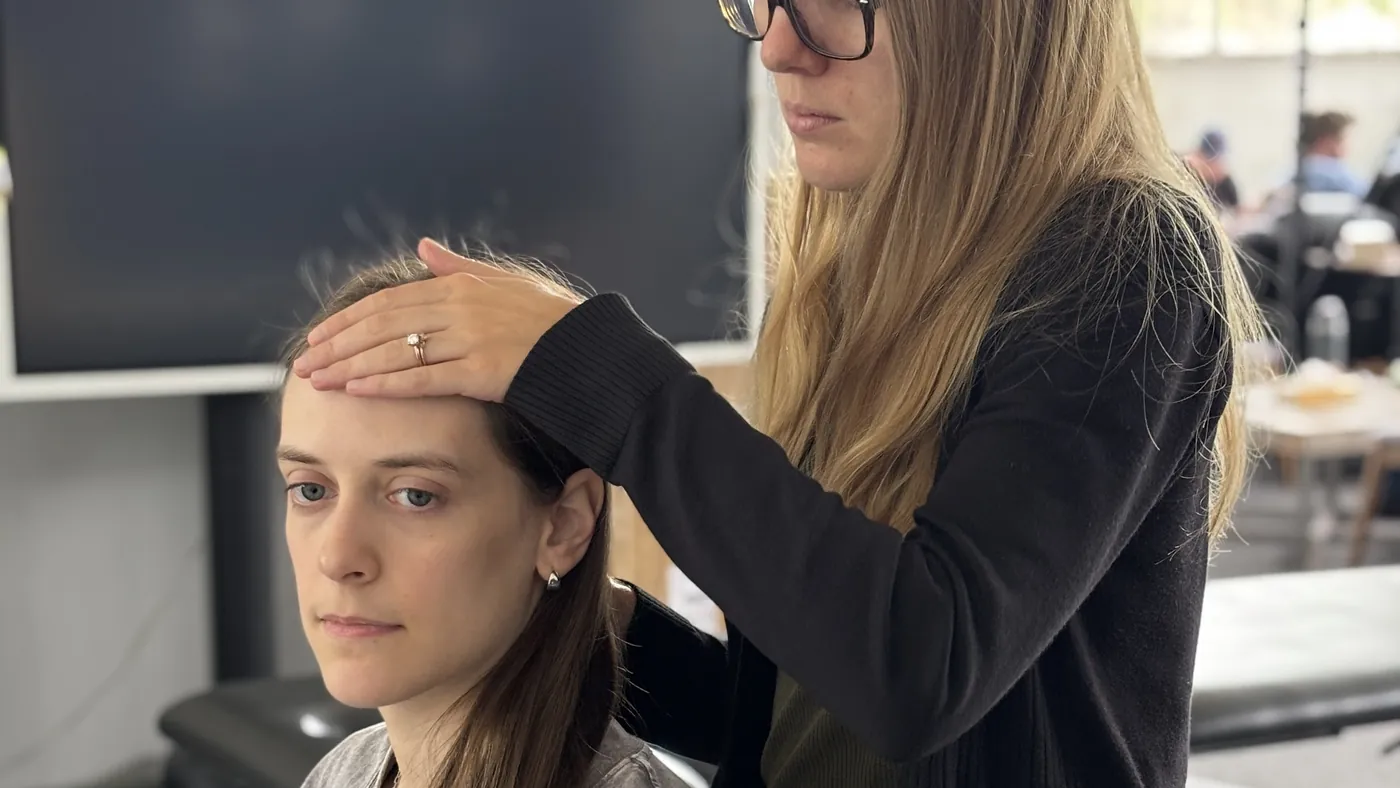
Our team looks at structure too, then tests how the neck functions in different situations: how your eyes move, what happens when you're thinking, walking or lying down, and how blood flow to the brain responds when your head turns or tips.
Treatment uses a dosed signal, such as light contact on specific neck segments so your brain can feel them, assisted movement, or resistance that makes the muscles send a bigger signal. After each input we recheck an output, such as eye alignment on a Maddox rod test, the CO2 in your breath, heart rate or the reflex that steadies your eyes when your head moves, to make sure the dose helped. For many people with autonomic symptoms the right dose is far lower than expected, which is where many neck programs go wrong.
See the neck's effect on blood flow in 3D
Our 3D tour shows what a standard tilt test watches as the table brings you upright, then what our testing adds: blood flow to the brain, the CO2 in every breath and a hands-on bedside exam.
Take the 3D Tour2 of the patient cases trace back to the neck: Hannah, a college student whose head turns cut blood flow to one side of her brain and set off skipped heartbeats, and Laura, whose whiplash left certain head movements pinching a carotid artery until she fainted.
Key Takeaways
- The neck is an input structure: its position sensors report to the brainstem and cerebellum, and the vertebral arteries that feed the back of the brain climb through the neck bones.
- Faulty neck input can show up as dizziness, vision problems, headaches, heart rate spikes, gut problems, clumsiness, brain fog and memory trouble.
- Neck posture is set by the brain, so structural fixes often fade unless the brain's reading of the neck improves.
- Testing the neck during eye movement, thinking, walking, lying down and head turns shows whether it's driving your symptoms.
Neck Problems and the Brain: FAQ
Can neck problems affect your brain?
Yes. The upper neck is packed with position sensors that report to the brainstem and cerebellum, and the vertebral arteries that feed the back of the brain climb through the neck bones. Faulty signals or squeezed arteries can show up as dizziness, headaches, blurred vision, heart rate spikes, brain fog and memory problems.
Can neck problems cause brain fog and memory problems?
They can, because a brain running on bad position data from the neck, along with headaches, vision strain, autonomic swings and reduced blood flow, has less capacity left for thinking. People describe mental fatigue, trouble finishing a thought, short-term memory slips and words that won't come, and multitasking makes it worse.
Can a neck injury cause POTS or dysautonomia?
A neck injury can drive POTS-like symptoms. Neck joints and muscles feed the brainstem, where autonomic reflexes are coordinated, and faulty input can produce heart rate spikes, blood pressure swings and gut problems. Head turns can also reduce blood flow to the brain, and the heart races to make up for it. This pattern is sometimes called cervicogenic dysautonomia.
Can neck problems cause dizziness?
Yes. Balance depends on the eyes, the inner ears and the neck agreeing about where your head is. When injured or stiff neck joints send inaccurate position signals, the reports conflict, and the result is dizziness, unsteadiness or vertigo. This is called cervicogenic dizziness, and it's often missed after whiplash, concussion or falls.
How does the neck affect blood flow to the brain?
The vertebral arteries pass through a bony tunnel in the side of each neck bone on their way to the brainstem. Joint misalignment, disc problems, muscle spasm or ligament laxity can squeeze these arteries from the outside, reducing blood flow and producing lightheadedness, visual disturbances, slowed thinking and fatigue, often with certain head positions.
Can neck tightness cause brain fog?
It can contribute, because tight, guarded neck muscles change the position signals the neck sends and can feed headaches and reduced blood flow, all of which tax thinking. Tightness is often the brain's protective response, so stretching alone tends to give short relief unless the brain's control of the neck improves.
Why does my neck cause headaches and vision problems?
Neck position feeds the reflexes that aim and focus the eyes, so cervical joint errors can disrupt binocular vision, focusing and depth perception even when the eyes are healthy. Headaches follow distinct patterns: muscle trigger points refer pain behind the eyes, while joint dysfunction tends to create band-like pressure around the head.
Keep Reading
Sources
- Peck D, Buxton DF, Nitz A. A comparison of spindle concentrations in large and small muscles acting in parallel combinations. Journal of Morphology. 1984;180(3):243-252. doi:10.1002/jmor.1051800307
- Kristjansson E, Treleaven J. Sensorimotor function and dizziness in neck pain: implications for assessment and management. Journal of Orthopaedic and Sports Physical Therapy. 2009;39(5):364-377. doi:10.2519/jospt.2009.2834
- Bolton PS, Kerman IA, Woodring SF, Yates BJ. Influences of neck afferents on sympathetic and respiratory nerve activity. Brain Research Bulletin. 1998;47(5):413-419. doi:10.1016/s0361-9230(98)00094-x
Dr. Keiser is a board-certified chiropractic neurologist (DC, DACNB, FABBIR), not a medical doctor (MD/DO). This content is for educational purposes and does not constitute medical advice. It is not a substitute for professional medical evaluation, diagnosis, or treatment. Always consult a qualified healthcare provider about your specific situation.
Get Your POTS & Dysautonomia Roadmap
A free guide to understanding what's actually happening in your brain, and what to do about it.
Get the Free Roadmap
Ready to talk it through? Schedule a visit